Login

Question

Show More

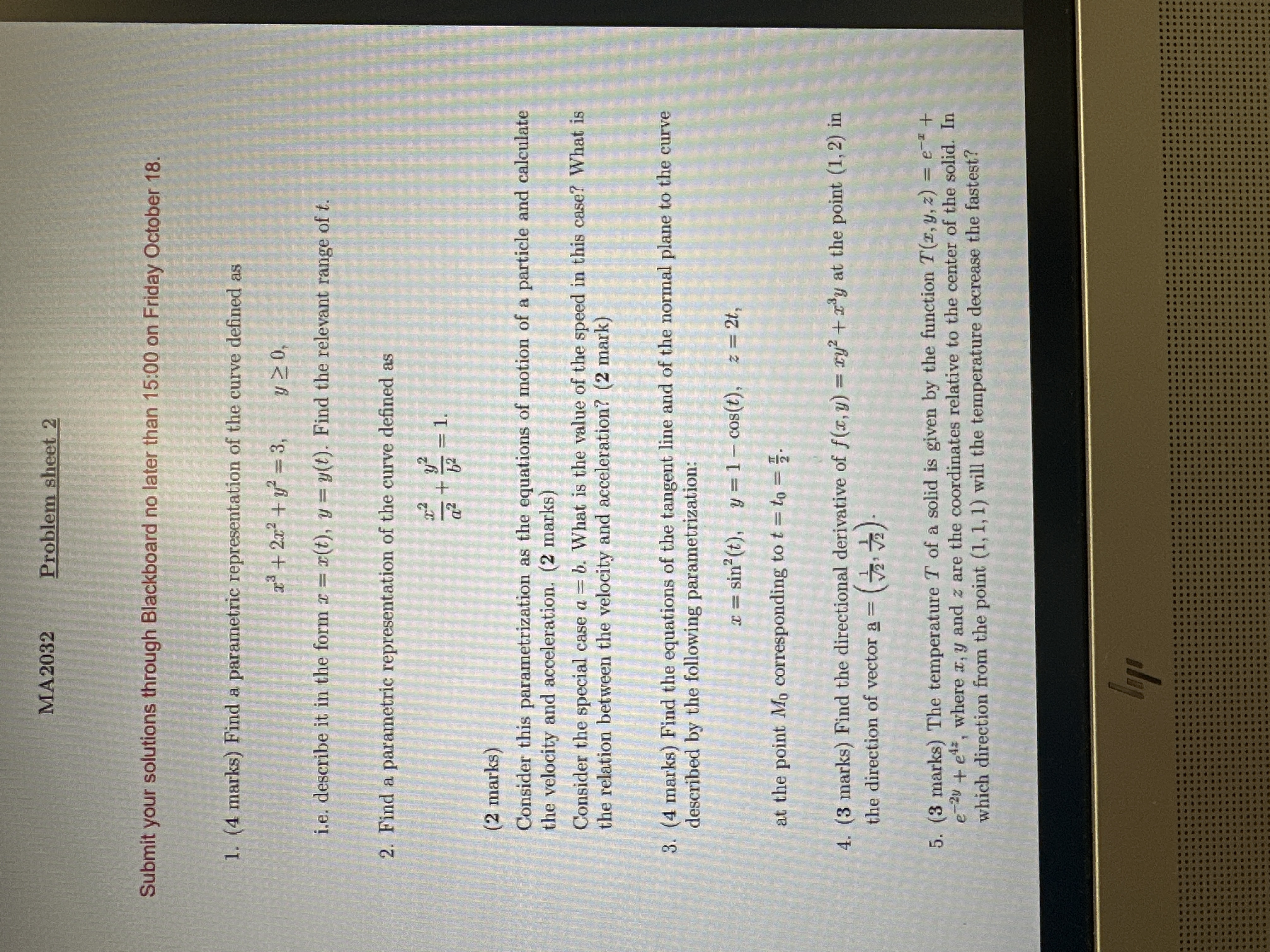
1. Find a parametric representation of the curve defined as \( x^3 + 2x^2 + y^2 = 3, y \geq 0 \), i.e., describe it in the form \( x = x(t), y = y(t) \). Find the relevant range of \( t \). <br/> <br/>2. Find a parametric representation of the curve defined as \( \frac{x^2}{a^2} + \frac{y^2}{b^2} = 1 \). <br/>Consider this parametrization as the equations of motion of a particle and calculate the velocity and acceleration. <br/>Consider the special case \( a = b \). What is the value of the speed in this case? What is the relation between the velocity and acceleration? <br/> <br/>3. Find the equations of the tangent line and of the normal plane to the curve described by the following parametrization: <br/>\( x = \sin^2(t), y = 1 - \cos(t), z = 2t \), <br/>at the point \( M_0 \) corresponding to \( t = t_0 = \frac{\pi}{2} \). <br/> <br/>4. Find the directional derivative of \( f(x,y) = xy^2 + x^3y \) at the point \( (1,2) \) in the direction of vector \( a = \left( \frac{1}{\sqrt{2}}, \frac{1}{\sqrt{2}} \right) \). <br/> <br/>5. The temperature \( T \) of a solid is given by the function \( T(x,y,z) = e^{-x} + e^{2y} + e^{4z} \), where \( x, y, \) and \( z \) are the coordinates relative to the center of the solid. In which direction from the point \( (1,1,1) \) will the temperature decrease the fastest?
StudyStudy

Solution

PrepMate

Ask a tutor

If you have any additional questions, you can ask one of our experts.

Recently Asked Questions